


Most dental websites don't fail because they look bad. They fail because they were designed for the wrong person — the dentist, not the patient. After building dental websites from the ground up for practices across Ontario, we've seen what separates sites that quietly generate new patients every month from those that get traffic and nothing else.
This guide isn't a generic checklist. It's grounded in what we've observed working with dental practices that had no prior web presence and needed their site to do real work from day one. One of our clients — a Thornhill-based dental clinic — now ranks #1 on Google for "Thornhill dentist" and receives an estimated 6–10 new patient inquiries per month through organic search alone, starting from a blank slate.
Here's what we've learned.
The first thing a potential patient wants to know isn't a list of every service you offer. They want to know three things quickly: Are you near me? Are you taking new patients? Can I trust you?
If your homepage doesn't answer those three questions within the first screen, you're losing patients before they even scroll. Design your homepage hierarchy around what the patient needs to decide, not what you want to showcase.
A family dentist in Thornhill serves very different patients than a cosmetic dentist in downtown Toronto. Before writing a single word of copy, identify who your core patient is: their age range, what they're worried about, whether they're searching in English or another language, and what would make them trust you enough to call.
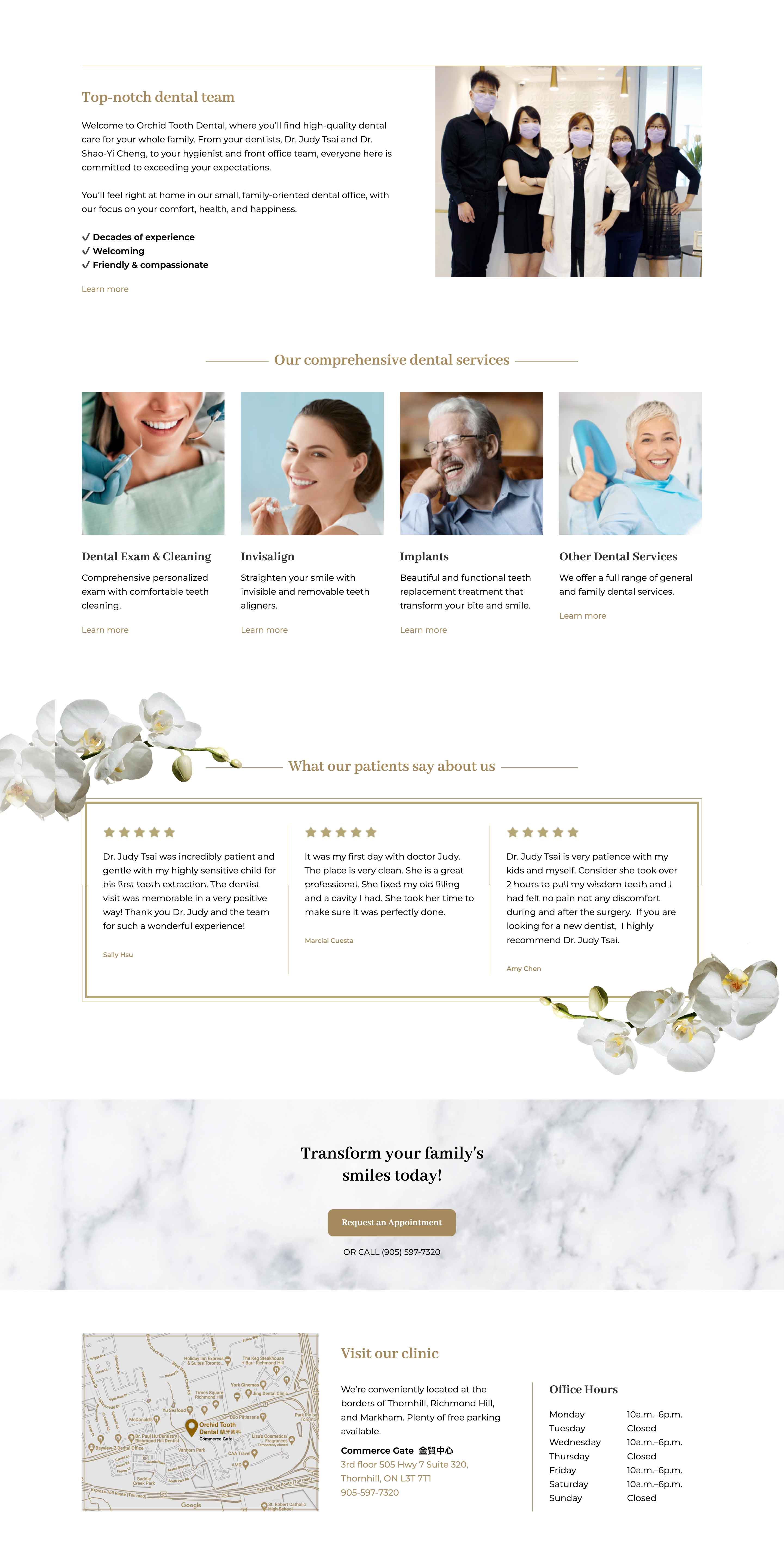
For one of our clients, Orchid Tooth Dental, who serves a large Taiwanese-Canadian community, we optimized the site bilingually. That clinic ranks #1 for "Taiwanese dentist" in the GTA — a long-tail keyword with very high intent and very few competition.
The lesson: niche specificity beats generic positioning every time, both for SEO and for patient conversion.
A dental clinic doesn't need national visibility. It needs to be the first result when someone in a 5 km radius searches for a dentist. That means local SEO needs to be baked into the site architecture from the start, not bolted on afterward.
The foundations: your Google Business Profile must be fully built out and match your website's NAP (name, address, phone number) exactly. Your site needs location-specific landing pages, not just a generic "contact" page. And your URL structure, title tags, and H1s should include your city and neighbourhood, not just "dental services."
Broad keywords like "Toronto dentist" are extremely competitive and expensive to rank for. A smarter approach for a new dental site is to target high-intent, lower-competition keywords first — neighbourhood-level terms ("Thornhill dentist," "North York family dentist"), procedure-specific terms ("Invisalign Thornhill," "dental implants Markham"), and community-specific terms if your practice serves a particular demographic.
Starting with these terms lets you build authority in a niche before competing for broader keywords. Our Thornhill client achieved a page 1 ranking within 4 months of launch using this approach without any paid ads.
Google's Helpful Content system is increasingly good at identifying whether a page was written for humans or for algorithms. The former ranks; the latter doesn't. For dental sites, this means your blog and resource pages need to answer real patient questions with real depth not just restate the same surface-level advice found on every other dental website.
What works: procedure explainers written in plain language, FAQs that anticipate actual patient anxieties ("Does getting a crown hurt?" "How long does Invisalign take?"), and local content that connects your practice to the community it serves.
Mobile-first is non-negotiable. Over 60% of local dental searches happen on mobile. Your site must load fast (under 3 seconds), have properly structured heading tags, and include local schema markup so Google understands your business details. Your sitemap should be submitted to Google Search Console at launch, not six months later.
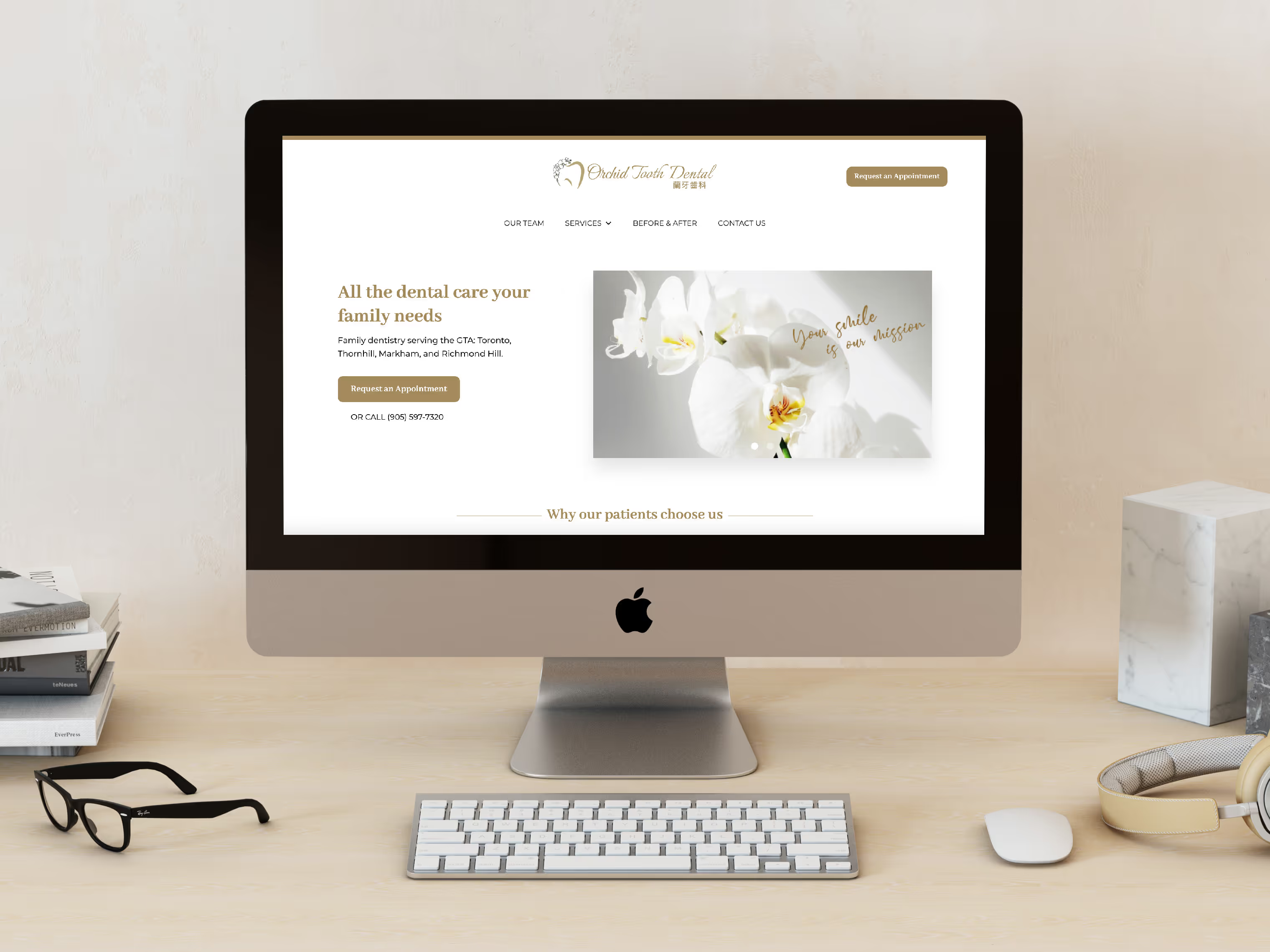
There's a version of dental web design that looks stunning in a portfolio but generates zero leads. Over-designed sites with heavy animations, slow load times, and unclear navigation can actually hurt conversion rates. The best dental websites we've built are clean, fast, and relentlessly focused on getting the visitor to take one action: contact the clinic.
Clear calls-to-action above the fold. Your "Book an Appointment" or "Call Us" button should be visible without scrolling on every device. Don't make patients hunt for it.
Phone number in the header. On mobile, it should be a tap-to-call link. This single change can meaningfully increase inbound calls from mobile visitors.
Social proof near the top. Google review stars, a patient testimonial, or a "Accepting New Patients" badge builds trust in the first few seconds. Don't bury testimonials at the bottom of a long page.
Simplified navigation. Dental patients typically look for: Services, About the Team, Location/Hours, and Contact. Keep the menu focused on those paths.
Professional photography. Stock photos of smiling models undermine trust. Real photos of your clinic, your team, and (with consent) your patients signal authenticity. This is one of the most overlooked elements in dental web design.
Accessibility affects both inclusivity and SEO. Ensure your site uses proper heading hierarchy, alt text on all images, sufficient colour contrast, and keyboard-navigable menus. Google's crawlers read your site much like a screen reader does — an accessible site is also a more indexable site.
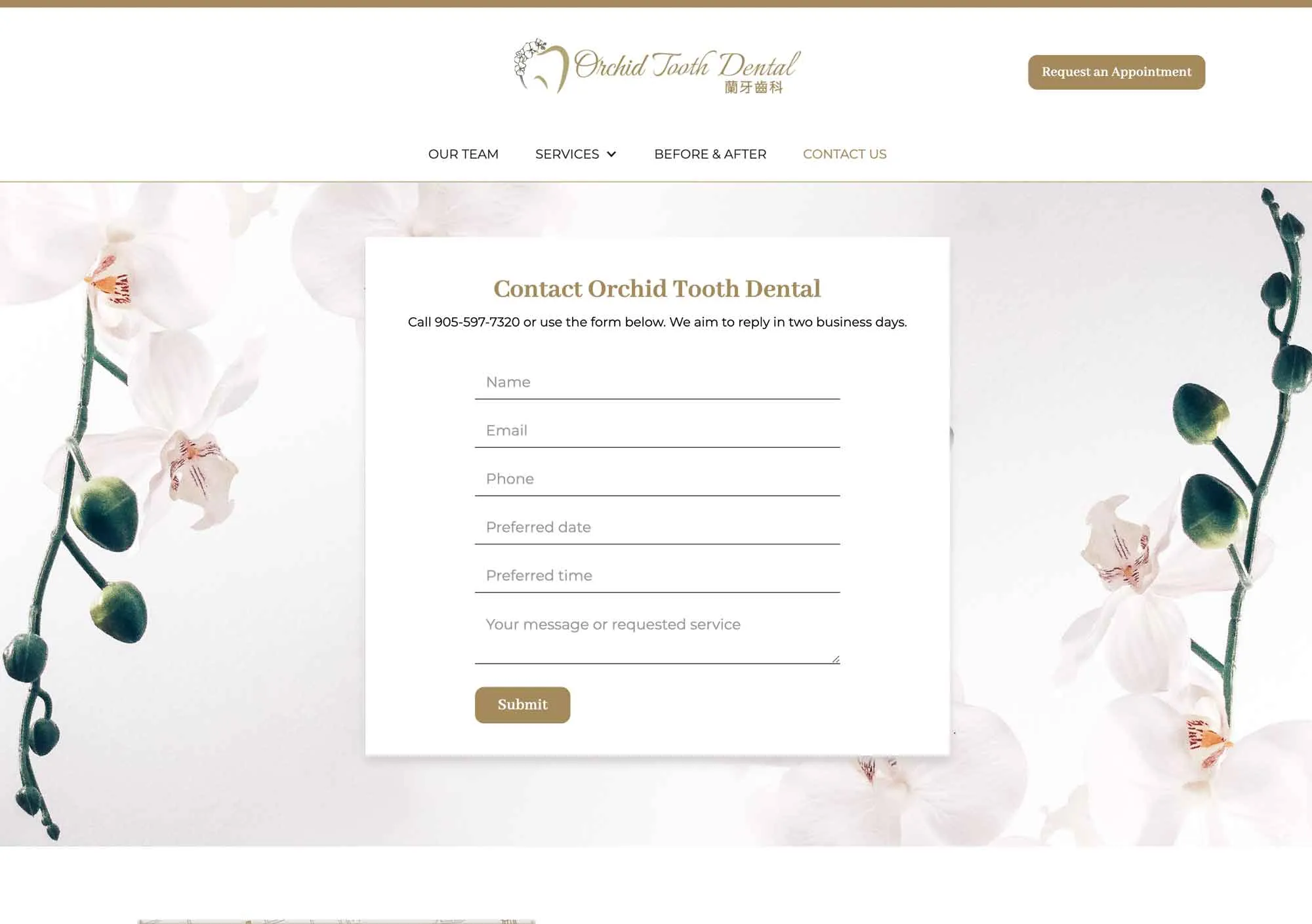
Different patients prefer different contact methods. Younger patients often prefer filling out a form on their own time; older patients often want to call. Your site should accommodate both with equal prominence. A simple appointment request form asking only for name, phone, preferred date, and reason for visit converts better than a long intake form.
Real-time chat tools can meaningfully reduce the gap between interest and action, especially during evenings when the clinic is closed. A simple chatbot that captures name and contact information and promises a callback the next morning can recover inquiries that would otherwise be lost.
A patient who lands on your site for the first time doesn't know you. Before they'll fill out a form or pick up the phone, they need to feel confident you're legitimate, competent, and the right fit. This is where your About page, team bios, credentials, patient testimonials, and Google reviews do the heavy lifting. Don't skip these pages — they're part of your conversion funnel, not decoration.
For a dental practice starting from zero, here's a realistic timeline based on our experience building dental websites from scratch:
Months 1–3: Design, build, and launch. A well-built dental site takes 2–3 months from kickoff to going live. Rushing this phase leads to technical debt that hurts SEO later.
Month 4: Early organic traction. With proper on-page SEO, a Google Business Profile, and correct technical setup, some neighbourhood and long-tail keywords begin ranking. This is when the first organic inquiries typically arrive.
Months 6–12: Authority builds. As the site accumulates backlinks, Google Search Console impressions grow, and content is added, rankings improve for more competitive terms. This is a compounding processTthe site gets more valuable over time without ongoing paid spend.
One of our dental clients went from no website to ranking #1 for "Thornhill dentist" within 4 months of launch with no paid ads, starting from zero domain authority.
A dental website is not a one-time project. Google rewards sites that are actively maintained. New content signals freshness, updated service pages reflect your actual offerings, and regular technical audits catch issues before they hurt rankings.
At minimum, plan for: monthly content updates (even one new blog post or FAQ), quarterly technical audits (broken links, page speed, mobile rendering), and annual design reviews to ensure the site hasn't fallen behind modern standards.
Patient reviews should also be cultivated continuously. A practice with 12 Google reviews looks less established than one with 80+. Building a system to consistently ask patients for reviews. A follow-up email, a text after their appointment should be part of your marketing process from day one.
A dental website that generates consistent new patients isn't magic. It's the result of designing for the patient's decision-making process, building a technically sound and fast site, targeting the right keywords from the start, and maintaining the site as a living asset rather than a one-time expense.
Every marketing channel — social media, Google Ads, referrals, signage — ultimately leads back to your website. It's the one piece of your marketing infrastructure worth getting right. If you're starting from scratch or rebuilding, don't treat it as a cost. Treat it as your best-performing salesperson.
FAMGO Design is a Toronto-based web design agency specializing in high-performance dental websites built for patient acquisition. We work with dental practices that are starting from zero. No existing site, no domain authority and build sites designed to rank and convert from the ground up.
Every dental site we build includes conversion-focused design, local SEO architecture, professional copywriting, Google Business Profile setup, and Search Console configuration at launch, not as add-ons.
If you're a dentist in Toronto or the GTA looking to grow your patient base through your website, we'd be glad to show you what's possible.
Book a free consultation: famgodesign.com/contact
Book a 100% FREE, no obligation, consultation call with us.
Experience how FAMGO can set you apart, rank higher on, and convert more customers.


